
Cyprus Mandatory Tax Returns: What Everyone Needs to Know About the New Filing Rules
Cyprus is changing the way individuals handle their tax obligations, and ignoring these changes could cost you more than you expect. With new requirements under the 2026 tax reform, more residents will need to submit an annual income tax return, including certain individuals who earn little or no income.
For years, many people in Cyprus have assumed that if their salary is below the taxable income threshold, they do not need to submit a tax return. Others believe that because their employer deducts tax directly from their salary, their tax obligations are automatically taken care of. These assumptions can lead to problems, particularly as the new rules expand the categories of individuals required to file.
The changes are also introducing a transition between the existing TAXISnet platform and the newer Tax For All (TFA) system. Understanding which platform applies, who must submit a return, and when the relevant deadlines fall is essential for remaining compliant.
In this guide, we explain what is changing, why the government is introducing these requirements, who needs to submit an income tax return, what penalties may apply for late filing, and how to access the relevant online systems.
Important: The rules for the 2025 tax year differ from those applying to the 2026 tax year. As of October 2026, the 2025 individual income tax return is being submitted through TAXISnet, while returns for tax year 2026 onwards are scheduled to be submitted through Tax For All.
What Are the New Mandatory Tax Returns Submission Rules in Cyprus?
The main change is that the obligation to submit an annual individual income tax return is being expanded under Cyprus’s 2026 tax reform.
Previously, for the 2025 tax year, the general filing requirement applied to employees, pensioners and self-employed individuals whose gross annual income exceeded €19,500, subject to the applicable rules.
From the 2026 tax year onwards, the obligation is broader. Cyprus tax residents will generally be required to submit an income tax return if they have gross income falling within the scope of the Income Tax Law, regardless of their age. In addition, tax residents aged 25 to 70 during the relevant tax year must generally file a return regardless of the amount of their income, including where they have no income.
This means that being below the tax-free income threshold does not automatically mean you are exempt from filing a tax return.
It is important to understand the difference between owing income tax and being required to submit a return. These are two separate obligations.
An individual may have no income tax to pay but still be legally required to submit a declaration of their income and other relevant information to the Tax Department.
The new rules are intended to broaden reporting coverage and improve the administration of the tax system. The official guidance also confirms that certain individuals may be exempted through specific decisions by the Council of Ministers.
Why Is Cyprus Making Tax Returns Mandatory for More People?
The expansion of mandatory tax returns is part of a broader effort to modernise tax administration and improve the collection and verification of financial information.
There are several important reasons behind the change.
Better visibility of income
Not everyone earns money in the same way. Some individuals receive a monthly salary, while others earn income through self-employment, rental properties, investments or activities outside their primary employment.
A broader filing requirement allows the Tax Department to obtain a more consistent picture of taxpayers’ financial circumstances.
For example, someone might work full-time for a Cypriot company while also receiving rental income from a property. Looking only at the salary paid by the employer would not necessarily provide a complete picture of that person’s income.
Annual tax returns provide a formal mechanism for declaring relevant income from different sources.
Greater tax compliance
The authorities need reliable information to assess whether individuals are meeting their tax obligations.
When more people are required to submit returns, the Tax Department can improve its ability to compare declarations with information available through other reporting and administrative systems.
This does not mean that everyone submitting a return will automatically owe tax. It means that the authorities have a more structured process for determining whether a person has a filing obligation and whether their tax position has been correctly reported.
Modernising the tax system
Cyprus is also transitioning towards the Tax For All platform, which is intended to centralise and modernise various tax administration services.
This transition means taxpayers must pay attention not only to the information they submit, but also to the platform through which they submit it.
The existing TAXISnet platform remains relevant for the 2025 individual income tax return. From the 2026 tax year onwards, individual income tax returns are scheduled to be submitted through Tax For All.
For taxpayers, the practical lesson is straightforward: tax compliance is no longer something that should be considered only when an employer or accountant raises the issue. Individuals need to understand their own obligations and ensure that they are meeting them.
Who Must Submit an Income Tax Return in Cyprus?
One of the most important aspects of the reform is understanding which rules apply to your particular tax year.
The requirements are not identical for the 2025 and 2026 tax years.
For the 2025 tax year
For income earned during 2025, the filing obligation generally applies to employees, pensioners and self-employed individuals whose gross annual income exceeded €19,500.
The applicable requirement is based on the rules for the 2025 tax year, not the expanded filing requirement that takes effect from 2026 onwards.
The deadline announced for the 2025 individual income tax return is 31 October 2026.
From the 2026 tax year onwards
The new requirements broaden the obligation to submit an income tax return.
| Category | General filing requirement |
| Cyprus tax residents with relevant gross income | Must generally file, regardless of age |
| Cyprus tax residents aged 25–70 | Must generally file regardless of income, including where they have no income |
| Cyprus tax residents under 25 or over 70 with no gross income | Generally exempt under the stated age-and-income rules |
| Non-tax residents with relevant Cyprus-source income | Must generally file where the income falls within the applicable provisions of the Income Tax Law |
These categories are based on the published filing guidance. Specific exemptions or circumstances may affect an individual’s obligation, so the table should not be treated as a substitute for checking your own tax position.

Employees
Employees should not assume that their employer handles every aspect of their personal tax compliance.
Even if tax is deducted from a monthly salary, an individual may still have a separate obligation to submit an annual return.
From the 2026 tax year, an employee who is a Cyprus tax resident and falls within the mandatory filing categories may need to submit a return even if their income is below the applicable tax-free threshold.
Pensioners
Pensioners are not automatically exempt from filing simply because they receive a pension rather than a salary.
For the 2025 tax year, the general €19,500 gross-income threshold applies to pensioners covered by the announced filing requirement. From 2026 onwards, the broader rules must also be considered.
Self-employed individuals
Self-employed individuals should pay particular attention to their filing obligations because their income may not be taxed through a conventional employer’s payroll.
They may need to declare relevant income, account for allowable deductions and verify any tax liabilities arising from their activities.
The applicable filing requirements and deadlines should be checked separately from any other obligations, such as provisional tax payments or social insurance contributions.
Individuals with no income
This is one of the most significant changes.
A Cyprus tax resident who falls within the age range of 25 to 70 during the 2026 tax year may generally be required to submit an income tax return even if they earned nothing during that year.
For example, an individual who is 35 years old, currently unemployed and has no income should not automatically assume that no filing is necessary.
The important distinction is that the new requirement is based partly on age and tax residency, not exclusively on the amount of income earned.
Foreign nationals living in Cyprus
Foreign nationals should not assume that the rules apply only to Cypriot citizens.
The relevant factors include tax residency, the source and nature of income, age where applicable, and the legislation governing the relevant tax year.
A foreign national who is a Cyprus tax resident may fall within the same filing requirements as other tax residents. A person who is not a Cyprus tax resident may also have an obligation if they receive relevant income from Cyprus.
Because residence status and cross-border income can complicate the assessment, it is worth checking the applicable requirements before deciding that a return is unnecessary.
What Are the Fines for Not Submitting Your Tax Return?
Missing a tax deadline can have financial consequences, even if you believe that you do not owe any tax.
For the 2025 individual income tax return, the announced late-submission penalty is €150.
The following points are important.
Late submission penalty
The announced filing deadline for the 2025 tax return is 31 October 2026.
The Tax Department has also announced a specific relief measure under which interest and monetary charges will not be imposed where the relevant return is submitted and the corresponding taxes and contributions are paid by 30 November 2026, subject to the conditions of that announcement.
Do not assume that this additional period automatically changes every filing deadline or removes every possible penalty in every situation.
What if you have no tax to pay?
Having no tax liability does not necessarily remove the obligation to submit a return.
Under the expanded rules applying from 2026, some people must file even when they have no income. This is why it is important to distinguish between a tax return and a tax payment.
A person may be required to submit the return even though the final calculation shows that no income tax is due.
What if you owe tax but do not pay it?
Late filing and late payment are separate issues.
If a return results in tax being payable, the taxpayer must also comply with the applicable payment deadline. Depending on the circumstances and the relief measures in force, unpaid tax may attract interest or additional monetary charges.
For the 2025 tax year, the Tax Department has published a specific deadline-related relief measure extending the period for submission and payment without interest and monetary charges to 30 November 2026. Taxpayers should verify the exact scope of that relief and their individual position before relying on it.
What if you ignore the obligation entirely?
Ignoring a filing requirement can leave a taxpayer with an unresolved compliance issue. It may also complicate future interactions with the Tax Department, especially if the authorities subsequently request missing information or clarification.
The safest approach is not to wait for a reminder. Check whether you are required to file, identify the correct platform, and submit the return within the applicable deadline.
Important: The €150 figure relates to the announced late-submission penalty for the 2025 individual income tax return. It should not be presented as a universal penalty for every type of tax declaration or every future tax year. Other obligations may have different rules and consequences.
How to Access TAXISnet and Submit Your Tax Return
For the 2025 tax year, individual income tax returns are submitted electronically through TAXISnet.
The official platform is available here.
If you need to submit your 2025 return, follow these steps.
Step 1: Open the official TAXISnet website
Visit the official portal using the link above. Make sure you are using the government website rather than a third-party service.
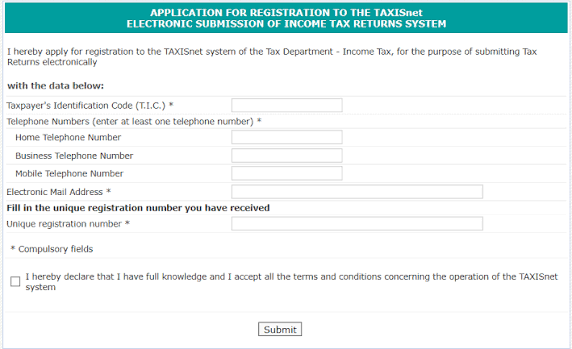
Step 2: Log in or register
If you already have TAXISnet credentials for income tax, log in using your username and password or PIN as requested by the system.
If you have a Tax Identification Number (TIN) but no TAXISnet account, follow the official registration procedure. Do not assume that having a TIN automatically means you have working login credentials.
Step 3: Select the individual income tax return
Navigate to the section for individual income tax returns and select the declaration for the relevant tax year, in this case 2025.
Make sure you select the correct tax year before entering any information.
Step 4: Review your information
Check the personal details and income information displayed or requested. Verify the relevant figures against your employment records, income statements and other supporting documents.
Do not assume that every field has been completed correctly just because information appears in the system.
Step 5: Complete and submit the declaration
Complete the required sections, review the declaration carefully and follow the portal’s instructions to submit it.
Check that the system confirms receipt or final submission. Save the confirmation and a copy of the submitted return for your records.
These are general navigation steps. The exact screens and options may vary depending on your registration and the declaration being submitted.
What if you cannot log in?
If you have forgotten your credentials or cannot access the platform, use the official recovery options or consult the TAXISnet registration guidance.
If you do not know your TIN or your unique 17-digit TAXISnet registration number, the Tax Department directs taxpayers to contact taxisnet@mof.gov.cy for assistance.
Do not leave the issue until the last minute. Registration or account-access problems can take time to resolve, and being unable to log in does not automatically mean that a filing deadline no longer applies.
TAXISnet vs Tax For All: Which Platform Should You Use?
One of the easiest mistakes to make during this transition is using the wrong platform.
Although both systems are connected to Cyprus’s tax administration, they serve different purposes during the transition.
| Tax year | Individual income tax return platform |
| 2025 and previous applicable years | TAXISnet |
| 2026 onwards | Tax For All (TFA) |
Individual income tax returns for tax years 2017–2025 are submitted through TAXISnet, while returns from tax year 2026 onwards are scheduled to be submitted through Tax For All.
You can access the newer system through the official government website.
If you are submitting your 2025 return in October 2026, you should use TAXISnet rather than assuming that the new system has already replaced it for that tax year.
For other tax declarations, the appropriate platform may differ. TAXISnet continues to support certain direct tax declarations, while other declarations are handled through Tax For All. Always check the instructions for the specific declaration you need to submit.
The Problem Nobody Wants to Talk About: Are Government Tax Platforms Actually User-Friendly?
There is another side to this change that deserves attention. While making tax submissions mandatory for more people may serve administrative purposes, the government also has a responsibility to ensure that the systems people are required to use are accessible, intuitive and genuinely fit for purpose.
Unfortunately, anyone who has tried to navigate government tax platforms in Cyprus knows that the experience can be far from straightforward. Interfaces can be confusing, instructions are not always clear, and finding the correct form, registration procedure or submission section can turn what should be a simple administrative task into an unnecessarily frustrating process.
Now imagine being an older person who is not comfortable using computers, navigating multiple online portals or understanding technical tax terminology. Imagine being told that you must submit a declaration online, but the system itself makes it difficult to understand where to start, which details to enter or how to confirm that your submission was successful.
Making something mandatory does not automatically make it accessible.
Requiring more people to complete online tax submissions without ensuring that the platforms are easy to use places an unfair burden on individuals who may already struggle with digital services. This is particularly concerning for older generations, people with limited digital skills and those who do not have an accountant or family member available to guide them through the process.
Digitalisation should make public services simpler, faster and more convenient. It should not mean transferring the administrative workload to citizens while leaving them to figure out poorly designed interfaces on their own.
If the government expects individuals to comply with new filing requirements, it should also ensure that the systems supporting those requirements are up to the task. That means clearer instructions, simpler navigation, accessible language, reliable technical support and practical alternatives for people who cannot reasonably manage the process online without assistance.
Tax compliance is already complicated enough. Citizens should not have to fight their way through a confusing website just to fulfil a legal obligation.
The responsibility cannot rest entirely on taxpayers. If submitting a tax return is a legal requirement, accessing and completing that process should be as straightforward as reasonably possible.
Until the systems improve, individuals should seek guidance when needed, allow enough time to complete their submissions and avoid assuming that a process is simple merely because it is available online.
What Documents and Information Should You Prepare?
Before starting your return, gather the information you need to complete it accurately.
Depending on your circumstances, this may include:
- Your Tax Identification Number (TIN) and relevant login credentials.
- Your personal details and tax residency information.
- Employment income statements and details of salary received during the relevant year.
- Pension income information, where applicable.
- Records of self-employment or business income.
- Details of rental income and other relevant income sources.
- Information about any other taxable income or applicable deductions and allowances.
- Records of tax already paid or withheld, where relevant.
Not every taxpayer will need every document listed above. The information required depends on the type of income you receive and the sections of the return that apply to you.
Accuracy is important. Incorrect figures, omitted income or incomplete information can lead to further questions from the Tax Department and may require corrections.
If you are unsure whether a particular source of income must be declared, it is better to clarify the position before submitting the return rather than making assumptions.

What Should You Do Now to Avoid Problems?
With the rules changing and the tax administration system transitioning, a few practical steps can help you stay organised.
First, identify the relevant tax year. The requirements for income earned in 2025 are not the same as those applying to 2026 onwards.
Second, check whether you are required to file. Do not base your decision solely on whether you owe tax or whether your employer deducts tax from your salary.
Third, confirm the applicable deadline. For the 2025 individual income tax return, the announced deadline is 31 October 2026, with the additional relief measure described above applying under the conditions announced by the Tax Department.
Fourth, make sure you can access the correct platform. Resolve registration or login problems early, and check whether TAXISnet or Tax For All applies to your declaration.
Finally, keep a record of your submission. Save the confirmation and relevant documents so you can demonstrate that you have completed the process if questions arise later.
Tax requirements can be confusing, especially for foreign nationals, self-employed individuals and people with income from several sources. If your circumstances are not straightforward, getting assistance can help you understand the process and avoid preventable mistakes.
How Rideo Group Can Help You Stay Compliant
Keeping up with tax obligations and regulatory changes can quickly become another administrative burden, particularly when you are also managing a business, working in Cyprus or handling relocation matters.
At Rideo Group, we understand that staying on top of changing rules and requirements is not always easy. Our goal is to help clients understand the procedures that apply to them, keep track of important changes and navigate administrative processes with greater confidence.
Whether you are an employee, a foreign national living in Cyprus or a business owner managing multiple obligations, having the right information at the right time can make a real difference.
Rideo Group is here to make these processes easier, help clients stay informed about relevant regulatory changes and provide assistance with the administrative steps involved in settling and managing life in Cyprus. Where specialist tax advice or tax-return preparation is required, we can help you identify the appropriate next steps and the relevant professional support.
Final Thoughts: Do Not Leave Your Tax Obligations Until the Last Minute
Cyprus’s expanded tax-return requirements are an important change that individuals need to understand before the new rules take effect for the 2026 tax year.
The key point is simple: not owing tax does not necessarily mean you are exempt from submitting a tax return. Under the new rules, certain Cyprus tax residents will need to file regardless of their income, while others will be covered because of the income they receive.
Check which rules apply to you, use the correct submission platform and pay attention to official deadlines. Taking a little time to understand your obligations now can help you avoid unnecessary penalties, delays and administrative complications later.
And if you are unsure where to start, Rideo Group is here to help make navigating Cyprus’s changing rules and regulations easier.
Disclaimer: This article provides general information based on guidance available as of October 2026. Tax obligations, exemptions, deadlines and penalties depend on the applicable legislation and individual circumstances. For confirmation of your specific filing requirements, consult the Cyprus Tax Department or a qualified tax professional.